

Our expertiseS
Computational fluid dynamics
Understand and master complex flows
Computational Fluid Dynamics (CFD) makes it possible to accurately study fluid behavior in complex industrial systems. It provides an in-depth understanding of flows, heat and mass transfer, in order to optimize the performance of your products and processes while limiting the need for experimental testing.
As an expert in CFD simulation, SIMTEC develops custom numerical models using COMSOL Multiphysics® to analyze the most complex fluidic phenomena and their interactions with other physics.
Models for all types of flows
SIMTEC is able to model many types of flows:
- Laminar flows;
- Turbulent flows;
- 2D or 3D flows, under steady-state or transient conditions;
- Free-flow or porous-media flows;
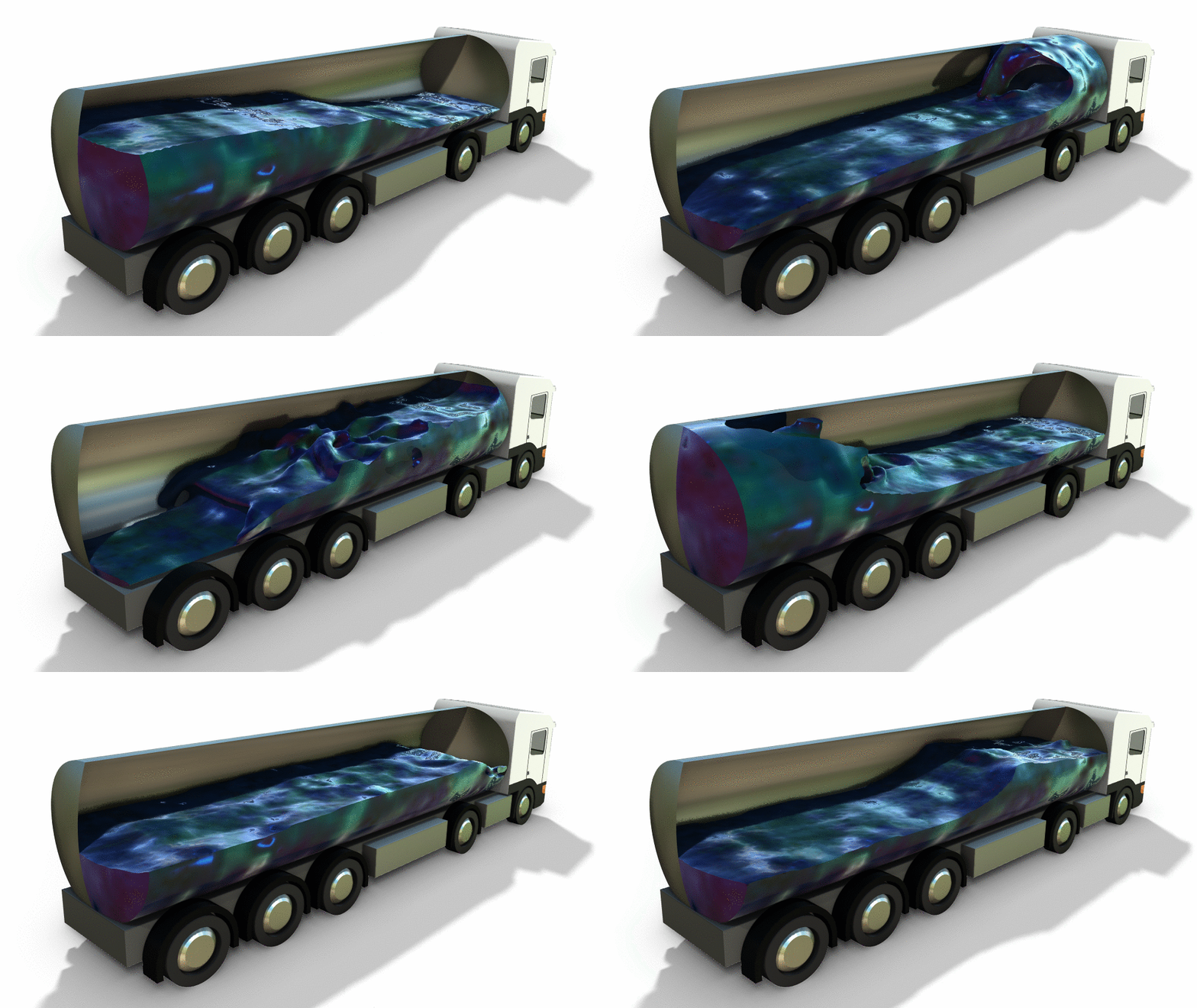
- Two-phase and multiphase flows, using the Level-Set, Phase Field, and Euler-Euler model methods;
- Free-surface flows, using the ALE (Arbitrary Lagrangian-Eulerian) and Level-Set methods;
- Flows in pipe networks;
- Compressible or incompressible fluids;
- Newtonian or non-Newtonian fluids;
- Fluid-Structure Interaction (FSI).
Thanks to our multiphysics approach, these models can be naturally coupled with heat transfer, structural mechanics, mass transfer, electromagnetism, or any other physics to obtain an accurate representation of the actual behavior of your system.
Turn flows into a performance driver
Numerical simulation makes it possible to visualize flows, identify critical areas, and quickly evaluate different design solutions before manufacturing a prototype.
Our calculations can be used, in particular, to:
- minimize pressure losses;
- improve flow homogenization;
- optimize heat and mass transfer;
- optimize fluid mixing;
- improve the hydraulic or aerodynamic performance of equipment;
- reduce development costs and development time.
Couple flows with other physical phenomena
In most industrial applications, flows are closely linked to other physical phenomena. Heat transfer modifies fluid properties, mechanical stresses can deform structures, while chemical reactions influence mass transfer.
The modeling tools used by SIMTEC make it possible to naturally couple fluid mechanics with heat transfer, structural mechanics, mass transfer, or any other physics in order to simultaneously solve all the phenomena involved. This multiphysics approach ensures highly accurate results and a better representation of the actual behavior of your products and processes.
Flow analysis is an essential driver for optimizing the hydraulic, thermal, and energy performance of many industrial systems.