
Our expertiseS
Heat transfer
Understanding heat transfer mechanisms
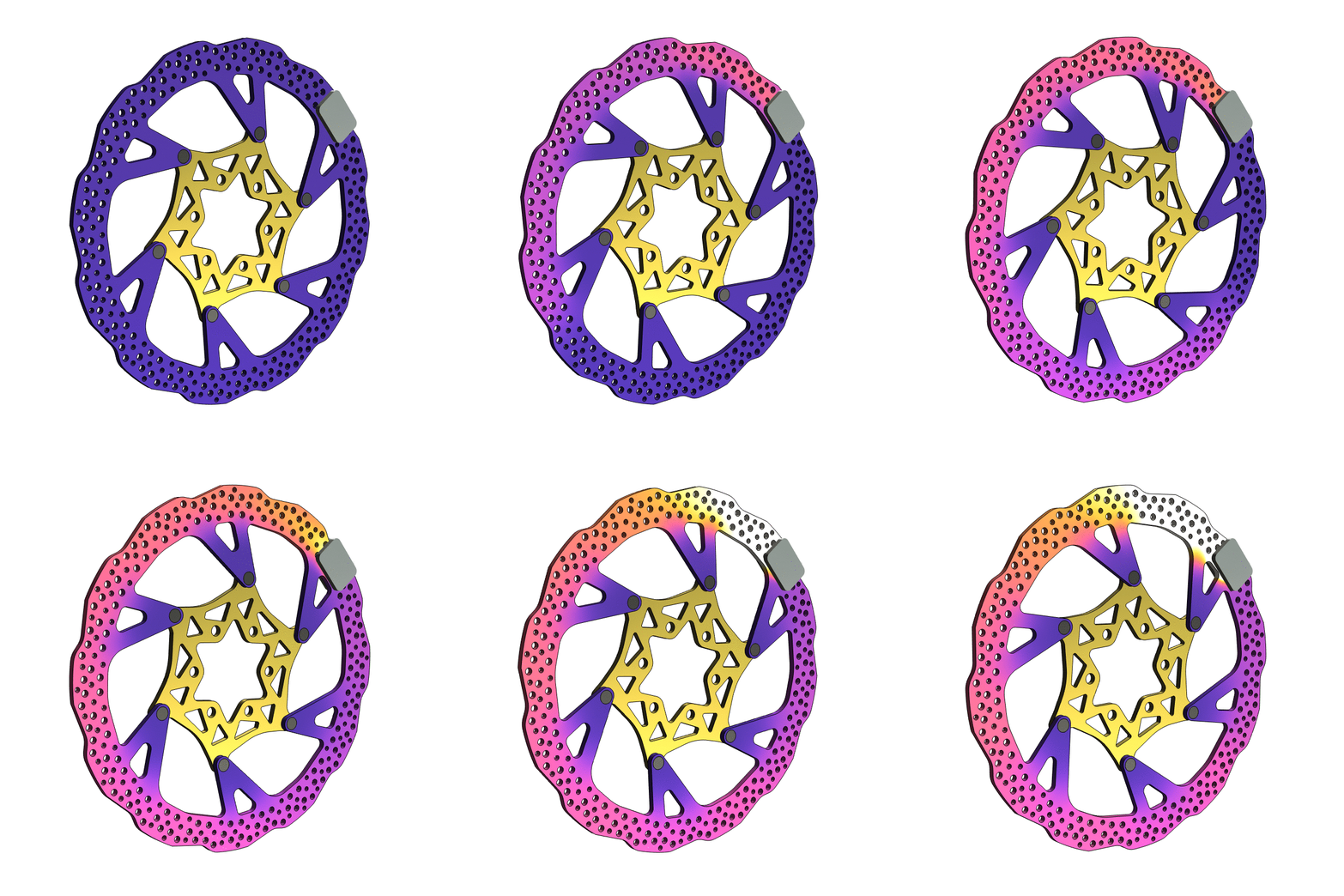
Mastering heat transfer is a major challenge in many industrial applications. Heat transfer modeling makes it possible to accurately determine the dynamics and spatial distribution of temperature within a product or industrial process. It is an essential tool for understanding physical phenomena, predicting the thermal behavior of a system, and optimizing its performance.
Thanks to its expertise in multiphysics simulation, SIMTEC develops custom numerical models using COMSOL Multiphysics®, capable of accurately representing heat transfer and its interactions with other physical phenomena.
Mastering heat transfer modes
SIMTEC models all heat transfer mechanisms, including:
- Conduction within a solid or fluid;
- Natural or forced convection;
- Thermal radiation, including black bodies, gray bodies, multi-cavity exchanges, and participating media (gases, flames, smoke, or semi-transparent media);
- Phase changes: melting, solidification, evaporation, and condensation.
These simulations can be carried out:
- in 2D or 3D;
- under steady-state or transient conditions;
- in coupling with other physical phenomena such as fluid mechanics, electromagnetism, structural mechanics, or process engineering.
Improving the efficiency of thermal processes
Thermal simulation makes it possible to reduce development costs while improving the performance of your products and processes. It allows different configurations to be virtually tested before prototypes are produced.
Our calculations can be used to optimize, in particular:
- the heating and cooling phases within a furnace, while minimizing thermal gradients;
- the cooling of a part or component;
- the thermal loading of parts to maximize their service life;
- the performance of heat exchangers;
- the cooling systems for industrial, electronic, or energy equipment;
- the energy consumption of your processes.
Physical interactions as close to reality as possible
In most industrial applications, heat transfer is closely linked to other physical phenomena. Fluid flows influence heat transfer, electrical currents generate heating through the Joule effect, while temperature gradients can cause mechanical deformation.
SIMTEC’s multiphysics and multi-scale approach makes it possible to take all these interactions into account in order to provide reliable results that accurately represent the actual behavior of your products and processes.
Our thermal models enable accurate analysis of heat transfer to improve the energy performance and reliability of your products and processes.