
client cases
Metallo-thermo-mechanical Model of Pulsed Laser Welding
the context
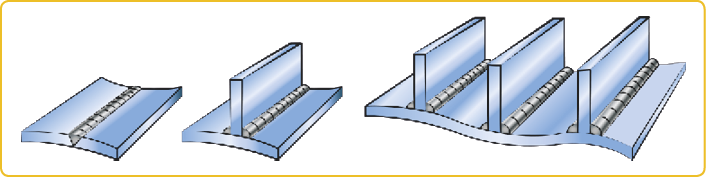
It is well known that due to localized and extreme thermal stresses the welding process generates non-uniform expansions and contractions. The latter can lead to significant residual deformations and stresses within the assembly. The numerical simulation of the welding process can approach these quantities for different modes of deformation typically encountered in industry and illustrated below:
In order to reduce development costs, numerical modeling is used to model the laser welding process to determine:
-
the level of residual stress, to prevent the risk of cracking
-
the resulting deformation, to provide design help.
Simtec actions & results
Based on thermomechanical and metallurgical characterization of the material, a numerical model of the welding process is built with COMSOL Multiphysics®. In partnership with the client, the following modeling approach has been chosen:
-
determination of a reference configuration for welding: welding of two plates « edge to edge »
-
identification of the heat source using the knowledge of the experimental molten zone and an optimization procedure
-
implementation of complex behavior of the material at high temperatures (non-linear kinematic hardening and viscoplastic effects)
-
complete thermo-mechanical computations taking into account metallurgical phase changes.
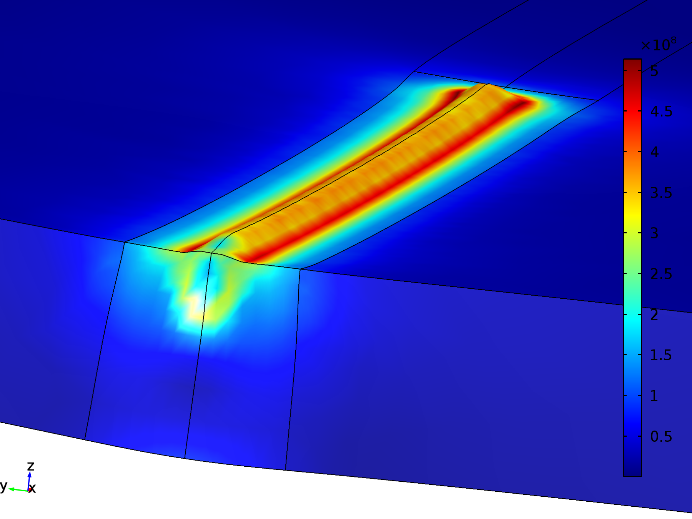
Modeling provides knowledge of the residual stresses within the assembly as well as the distortions after welding. An illustration of the von Mises stress after welding is shown here:
This type of calculation allows to meet industrial requirements according to the desired accuracy. If necessary, it is possible to study more precisely the mechanical behavior of the material at high temperatures (see Metallurgical Phase Change Modeling and Constitutive Relations and Characterizations ).