

publications
Empowering Shape Corrections for Optical Mirror Surfaces through Customized Electroactive Polymer-Based Forc.e-Actuators and Additive Manufacturing
Adv. Mater. Technol. 2025, 2402152
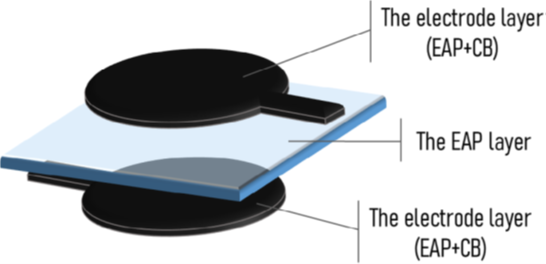
This research introduces a novel technology for creating lightweight, deformable optical mirrors with unique “live” capabilities. We developed dynamic hybrid electroactive polymer (EAP)-based force actuators integrated with the optical surface through advanced additive manufacturing techniques. By refining 3D printer software and hardware controls, we achieved better accuracy and reliability in fabricating complex geometries. Additionally, doping and multilayer structuring enhanced the electromechanical performance of the material. Our study examines how the thickness of the EAP actuator and electrode size affect optical glass displacement. We found that optimal performance occurs with EAP layers thinner than 300 μm, and larger electrodes delay saturation in deformation behaviors. Improved electromechanical response was observed with the organic plasticizer diisononyl phthalate (DINP). Our model, validated by COMSOL Multiphysics simulations, aligned well with experimental data. These findings represent a significant advancement in EAP-based actuators and their ability to correct optical surfaces precisely. They revolutionize the use of electroactive materials and open up exciting possibilities for future applications in active and adaptive optics, as well as precision control systems.
Intervenants :
Kritsadi Thetpraphi
School of Science, Walailak University, Thailand.
Gil Moretto, Francesca Rebasti
Centre de Recherche Astrophysique de Lyon (CRAL), France.
Vincent Bruyere
Simtec, Grenoble, France.
Jean-Fabien Capsal, David Audigier
Univ Lyon, France.
Jeff R. Kuhn
University of Hawaii’s, Maui, USA.